
ICAS scores recognise performance through clearly defined national standards, so every result is meaningful and every achievement earned.
ICAS is a rigorous academic competition and its achievement levels are built to reflect that. ICAS grades are determined by consistent, transparent performance thresholds, benchmarked not against a single classroom, but against tens of thousands of students across the country where the competition is hosted.
Every ICAS grade is measured against a national cohort, not a local average. Students know exactly where they stand relative to their peers across the country.
Achievement levels are determined by defined performance standards, applied consistently across every subject and year level.
The criteria behind every award are clear and publicly understood. Schools, parents and students can trust that ICAS grading levels reflect genuine academic performance.
A Distinction is a Distinction, regardless of where students participate. Standards don’t shift between schools, states or sittings.
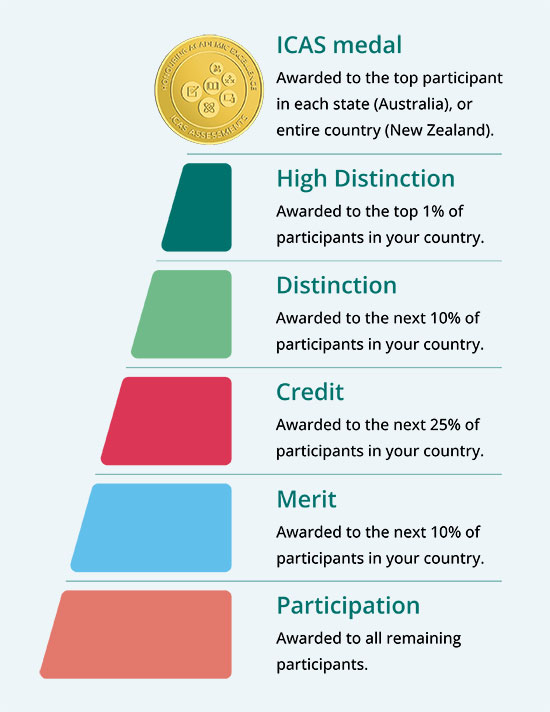
ICAS scores are structured across six levels, from participation through to medal.
Each level represents a defined standard of performance, recognised consistently across every subject and year level across the country where the competition is hosted.
For the highest achievers, ICAS offers recognition that stands out.
The achievement structure is deliberately designed so that no result is without meaning, whether a student finishes in the top 1% nationally or earns their Participation Certificate for embracing the challenge.
The ICAS medal is awarded to the highest-performing student per subject, year level and state — one of the most prestigious academic distinctions available to primary and secondary students.
A High Distinction places a student among the highest performers in the country for their subject and year level. It’s a grade that carries genuine weight in academic conversations, extension planning and beyond.
Structured grading bands mean students aren’t simply ranked and dismissed. Credit and Merit results reflect real academic ability against a national cohort — and that’s worth acknowledging.
Every student who enters receives formal recognition. Taking on a national academic challenge, regardless of the result, is something students can feel proud of.
The structured achievement levels of ICAS give schools a clear, nationally benchmarked framework to open richer academic conversations with students, parents and your own teaching team.
When you know a student has placed in the top 10% nationally, you have the evidence to support extension and set higher expectations. When a student earns a Credit or Merit, you have an externally validated picture of where they stand relative to peers — useful context for learning plans and parent discussions alike.
ICAS scoring is based on a student's performance relative to a national cohort, not their class or school average. This means an ICAS score reflects where a student sits among tens of thousands of peers across their country, providing a level of context that internal assessments can't offer.
For schools, this independent benchmark is valuable for identifying students who may be performing above or below expectations in a broader academic context.
The percentage bands for each ICAS achievement level remain consistent every year. High Distinction is always the top 1%, Distinction always the next 10%, and so on.
However, because ICAS grading is based on cohort performance rather than a fixed score, the raw mark needed to reach each level may vary slightly depending on the difficulty of the paper and how students perform overall. This ensures that standards remain fair and meaningful regardless of the assessment.
After all sitting windows have closed and results are finalised across all subjects, printed certificates are quality-checked and mailed to schools in a single delivery — typically 10 to 13 weeks after results are released.
Each certificate includes the student's ICAS grade and score details. Medals are produced separately and individually mailed to schools once confirmed. Schools then distribute certificates and medals to students at their own discretion, often through celebratory assemblies.
Absolutely. Each subject is assessed and graded independently, so a student might achieve a Distinction in Mathematics and a Credit in English, for example. This is one of the reasons ICAS grading is so useful for schools: it highlights where individual students are strongest and where there may be opportunity for targeted development, subject by subject.
ICAS is one of the most established academic competitions in the world, with over 40 years of history and the support of the University of Sydney in Australia.
ICAS achievement levels — particularly High Distinction and medal results — carry genuine weight in academic conversations, extension program selection and scholarship applications. Because ICAS scoring is nationally benchmarked and externally validated, schools and families can reference results with confidence.
Register your school for ICAS 2027 and let your students compete, achieve and be recognised on a national stage.