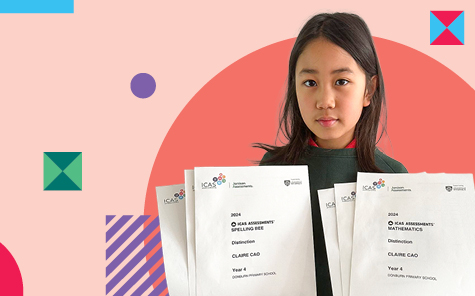
Your child’s ICAS results are designed to give you a clear picture of how they performed not just within their school, but against students across the country.
Each report breaks down performance by subject and skill area, making it easy to see where your child is thriving and where they’re continuing to grow.
Your child’s ICAS exam results include a detailed breakdown of their performance, not just a single number. These are some of the most valuable reports and insights.
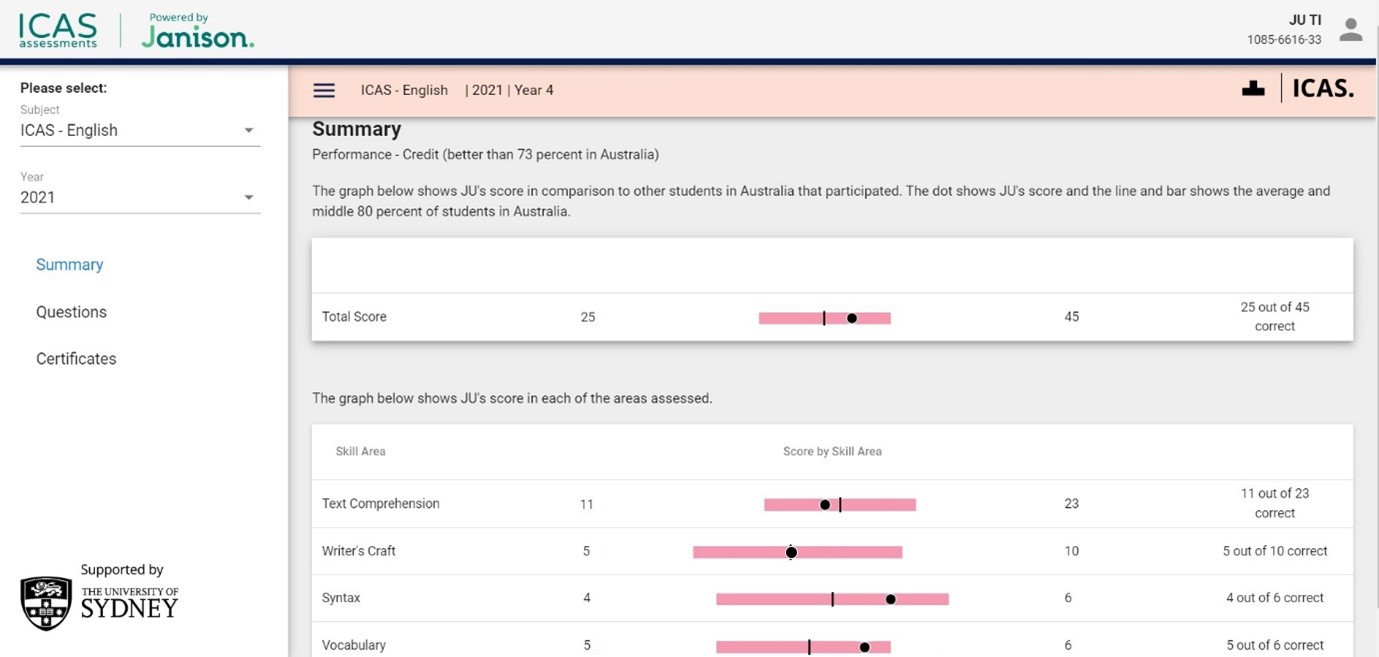
Your child’s summary report shows how they performed across every key skill area, compared to students nationally. It’s a clear, straightforward picture of their current strengths and a helpful guide for where a little extra support could make a real difference.
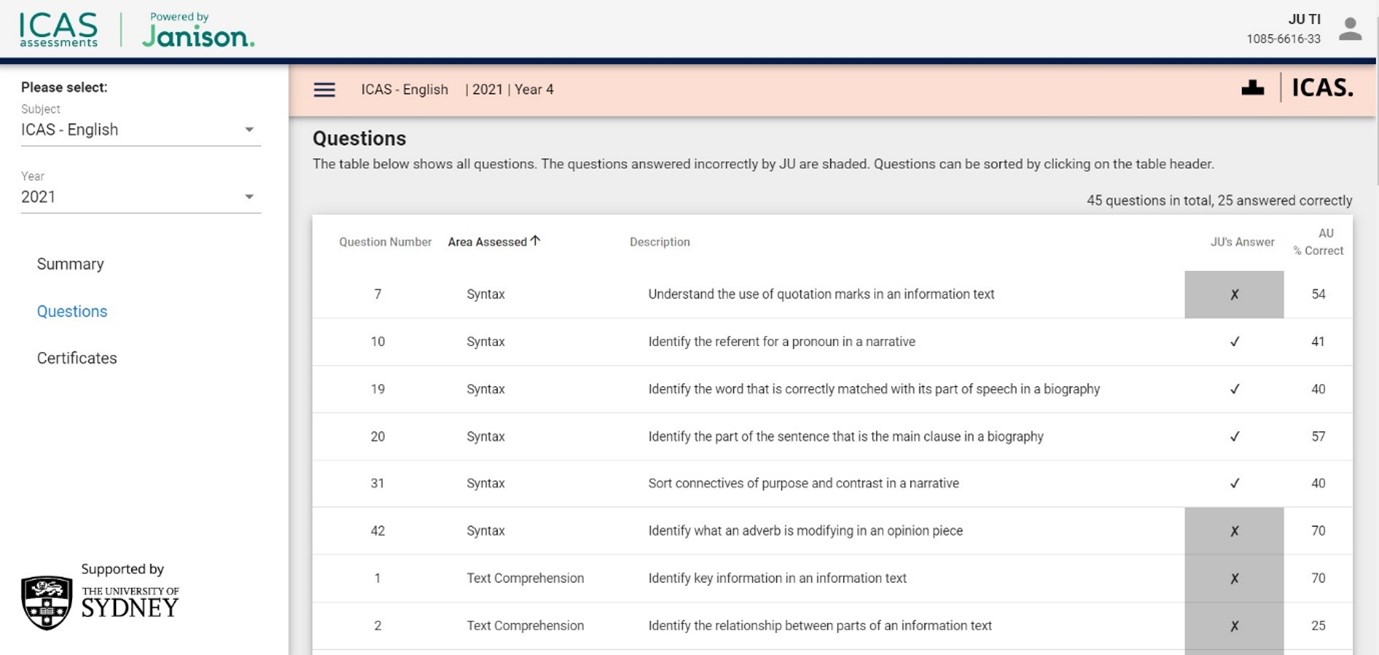
Beyond the overall score, ICAS results show which individual questions your child got right or wrong, and how the rest of the country performed on each. It’s the kind of detail that helps you and their teacher have informed conversations about their learning.

When your child takes part in ICAS tests across multiple years, you can track their progress over time — seeing real evidence of the effort and growth they’ve put in. It’s a motivating reminder that every challenge they take on is building something bigger.
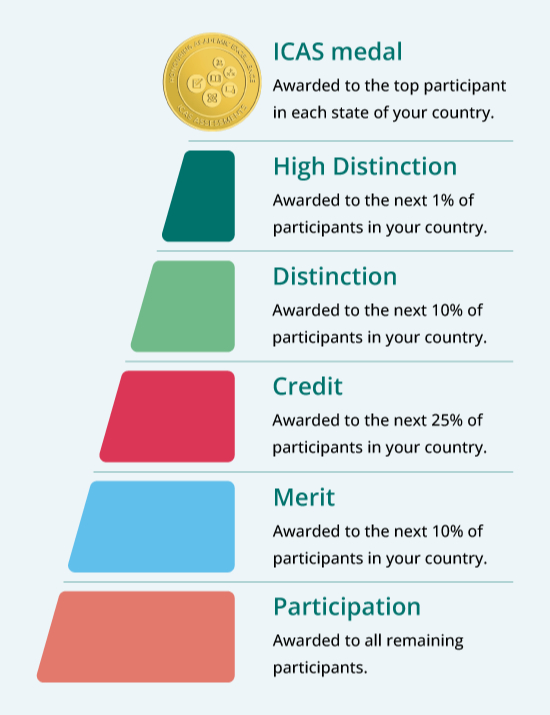
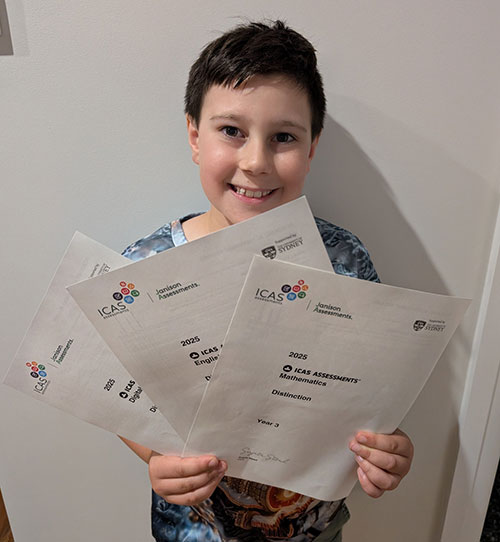
Every student who completes an ICAS assessment receives a certificate that reflects their level of achievement, and the very highest achievers are awarded medals too.
These aren’t participation trophies or arbitrary groupings. Every level is benchmarked against national results, so the recognition your child receives accurately reflects where they stand among students across their country, in their year level and subject.
A percentile shows how your child’s result compares to other students nationally. If your child is in the 75th percentile, they scored higher than 75% of participants in that subject and year level.
It’s worth remembering that a percentile reflects performance on this specific assessment, not your child’s overall ability, intelligence or potential. It’s simply a useful reference point, and one that becomes more meaningful when read alongside the detailed skill-area data in their report.
The most valuable thing about your child’s ICAS test result isn’t the number itself – it’s what you do with it. Here are four ways to approach the conversation.
Your child’s report highlights exactly where they performed well, giving you subject-level evidence of what they’re genuinely capable of.
Look for the skill areas where they scored highest and name them. “You’re really strong at this” is a powerful thing for a child to hear.
Where results show room to improve, that’s valuable information too. It’s a constructive signal for where a little more focus or support could make a real difference.
If your child’s teacher isn’t already aware, share your findings with them. It gives you both something concrete to work with.
Whatever the result, your child sat a nationally benchmarked academic competition and gave it their best. That takes confidence. Acknowledge it.
The habit of taking on challenges (and not just the ones they’ll definitely win) is worth more than any single score.
Use the insights from ICAS as a starting point for a conversation, not a conclusion. Ask your child how they found it. Talk to their teacher about what the results suggest.
And if they want to improve next time, past papers are available to help them practise with confidence.
ICAS results add independent, nationally benchmarked evidence to school and scholarship applications.
A strong result shows admissions and scholarship panels that your child has taken on a meaningful academic challenge and performed well. It’s effort today that can open doors tomorrow.
ICAS results aren’t just for parents. Schools receive the same detailed reporting and use it to inform academic conversations, identify students for extension and recognise those who may need extra support. This means you and your child’s teacher are always working from the same picture.
If you have questions about how your school uses ICAS results, their teacher or the school’s ICAS coordinator are great first points of contact.

ICAS results are released online approximately 10–15 business days after the final sitting day for each subject, with Writing taking around 4–6 weeks due to manual marking.
You can access your child's ICAS scores through the results portal using their unique TAP-ID and PIN. If you registered through the Parent Payment System (PPS), these credentials are emailed to you after purchase and again when results become available. If you don't have them, you can request them through the ICAS website or find them on the back of any current or previous year's certificate.
Not at all. It's important to remember that ICAS grades reflect performance against a national cohort on a paper specifically designed to challenge students beyond everyday classroom work. A result that looks modest in ICAS terms may still represent strong academic ability. The bar is deliberately high.
The most useful way to understand ICAS results is to look at the skill-area breakdown rather than focusing on the overall score alone. That detail shows you exactly where your child is strong and where a little extra focus could make a difference next time.
Your child's school grades are typically based on curriculum standards and assessed by their teacher, while ICAS scores are benchmarked independently against tens of thousands of students across the country. This means ICAS results offer a different perspective, one that can highlight strengths or gaps that school-based assessments may not surface, particularly for students who are already performing well in class. The two work best when read together, giving you a more complete picture of your child's academic ability.
Yes. Because ICAS grades are nationally benchmarked and externally validated, they carry genuine weight in scholarship and selective school applications. A strong result — particularly at Distinction or High Distinction level — provides independent evidence that your child has performed well against a rigorous academic standard.
Many families find that ICAS results add credibility to applications by demonstrating ability beyond school-based assessments.
The best place to start is your child's current results. Use the skill-area breakdown to understand ICAS results in detail, identify which areas they found most challenging and use that as a focus for practice.
ICAS past papers are available to purchase and are the most authentic way for your child to prepare, as they contain real questions from previous years. Check out our full suite of practice tools here.
Beyond formal practice, encouraging your child to read widely, solve problems in everyday contexts and approach the competition with a positive mindset, all contribute to a stronger experience next time around.
ICAS is a challenge your child can feel proud to take on — and a result they can learn from, whatever it shows. Enter your child today.