The Data-led Education Equity Program (DEEP) is an initiative that provides schools in low socioeconomic, outer regional, remote, very remote and Indigenous communities of NSW with valuable insights into student performance.
Supported by the University of Sydney, Janison and ICAS Assessments, the program allows educators to tailor teaching practices and drive improvements in student learning outcomes, helping close the education gap between low socioeconomic, remote & rural and metro schools.
The Data-led Education Equity Program (DEEP) is a University of Sydney sponsored initiative that enables Janison to provide the following valuable assessment tools to target NSW school communities, free-of-charge:
By providing industry-leading student assessment tools to participating schools, DEEP aims to improve education for students outside major cities.
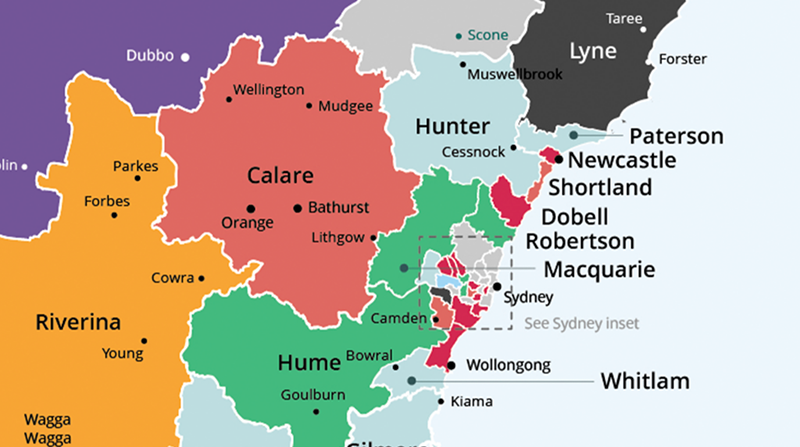
Click map above to view the location and number
of target schools per NSW Federal electorate

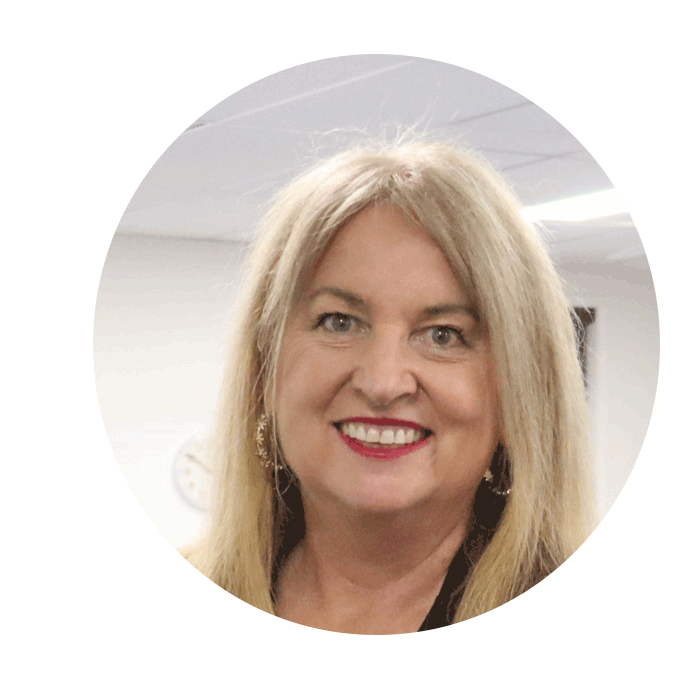



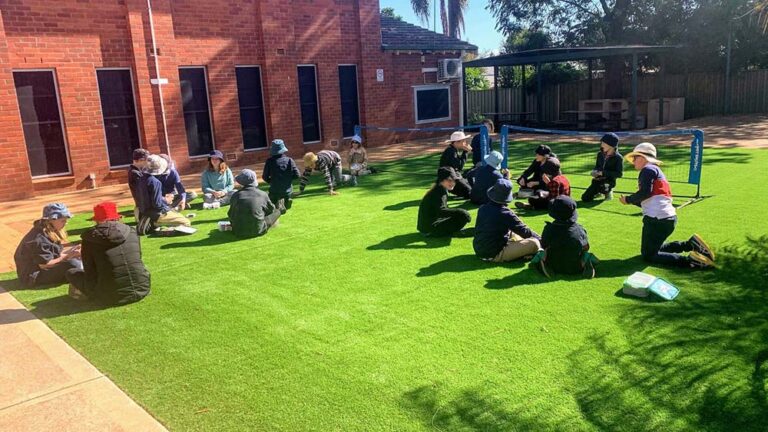
At Dubbo’s Central West Leadership Academy, year-on-year assessment data is helping teachers spot where students need support early, set meaningful goals, and check whether their strategies are working.
See how the DEEP program is making a difference.
Considering enrolling your school in DEEP? Learn more about the program and how you can get involved.
DEEP stands for the Data-led Education Equity Program.
Supported by the University of Sydney, DEEP underpins efforts to bridge the education equity gap among schools by giving those in outer regional, remote, very remote, Indigenous and low socioeconomic communities free-of-charge access to Janison’s industry-leading student assessment tools, Reach, ICAS, and PSAM.
DEEP is designed for schools in outer regional, remote, very remote, Indigenous and low socioeconomic communities. Selection for DEEP is at the discretion of Janison and the University of Sydney.
If you do not meet the eligibility criteria, contact us to discuss your school’s specific requirements and we will tailor an assessment package to suit your needs.
To apply for DEEP, contact us at [email protected]
Janison and the University are funding the following assessment tools for students in eligible schoosl:
Please contact us to find out how many assessment tools you can access for your school.
Schools participating in DEEP can also nominate up to 10 students to sit an ICAS assessment. If you have students who would like to participate in ICAS, contact us to discuss your requirements.
Yes. DEEP provides eligible schools with Reach, ICAS and/or PSAM assessment tools free-of-charge. However, if your school does not meet the DEEP selection criteria, you can still purchase them.
Contact us to discuss your school’s specific requirements and we will tailor an assessment package to suit your needs.
Schools participating in DEEP are subject to Janison’s Terms and Conditions.
Click here for full Terms and Conditions.
You can find the available subjects for each assessment tool below:
For PSAM, included subjects are English, Mathematics, the separate sciences, Geography and Economics, as well as extension courses, VET courses and any other course that contributes to ATAR. Learn more about PSAM here.
The setup process for Reach and ICAS depends on the subject as well as how many students you are enrolling.
As a general rule of thumb, we recommend allowing a minimum of two weeks.
However, if you need to set up your assessments within a shorter timeframe, please reach out to our assessment consultants at [email protected] who will be able to assist you.
The multi-faceted data insights derived from student assessment tools, like Reach, ICAS and PSAM, can help to inform more effective teaching strategies, drive student engagement, unlock student potential and elevate learning.
By giving schools in outer regional, remote, very remote, Indigenous and low socioeconomic communities these tools in a program that carries no financial obligation, we hope to help level the playing field and drive equitable learning opportunities.
All participating schools will receive login details for the results portal where they can access their online Reach, ICAS and/or PSAM reports via a self-service dashboard. This interactive dashboard includes streamlined report documents to view and print as well as a series of student and school certificates.
The results portals provide in-depth analysis of learning through various lenses. Whether it’s analysing data at classroom, year and school levels, or drilling down and understanding an individual’s learning needs, the results dashboard can provide invaluable insights to inform more effective teaching practices and improve overall results.
Participating schools will also have access to our assessment consultants who can explain how to best use the dashboard and get the most out of their reports.
Reach is a suite of annual online benchmarking assessments available across four literacy and three STEM subjects. Reach assessments identify students’ strengths, weaknesses and progress across entire classes or year groups. By providing objective data on students’ progression year on year, Reach enables educators to tailor methods, improve class allocations and apply effective teaching practices at scale.
ICAS is a globally renowned competition that identifies and unlocks students’ potential while also celebrating academic achievements. Spanning several STEM and literacy subjects, ICAS assesses students’ ability to apply classroom learning to new contexts using higher-order thinking and problem-solving skills.
The PSAM analysis platform gives schools the most rigorous senior-secondary insights available. It turns the complex process of scaling and ATAR calculation into clear, actionable intelligence—helping you understand, forecast and influence ATAR results with confidence.
Reach is a progression-testing and reporting platform for tracking performance and growth over time. By accessing Reach assessments, teachers can assess full cohorts and instantly pinpoint where each student sits against learning objectives, quickly remedying gaps with evidence-based teaching practices. The bigger benefit is workload: discovering gaps has long been a slow, challenging and imprecise process that placed a significant time and effort burden on teachers, and Reach is designed to take that burden off them. It gives teachers diagnostic data to target instruction precisely rather than guess where students are struggling.
ICAS is an academic competition that lets teachers benchmark their students against a wide national and international cohort. The main benefits for teachers are that it identifies high-achieving and gifted students who can be stretched with enrichment, gives recognition opportunities (awards, assemblies) that engage and motivate students, and supplies detailed results that can inform learning and teaching programs. Team leaders can assess results to discover enrichment opportunities for higher-ability students.
PSAM is the senior-secondary ATAR analysis tool. Its benefit to teachers is that it demystifies scaling and ATAR calculation, turning a complex process into clear insights they can act on. It helps teachers and school leaders see where to focus effort, identify which subjects or cohorts need attention, and forecast and influence ATAR outcomes with evidence. As one principal put it, PSAM helps schools understand where to focus their efforts, and if there's a challenge in a subject, they work closely with teachers to determine what needs attention.
The assessments provided through DEEP (Reach and ICAS) aren’t based on remembering certain facts or information and therefore no ‘studying’ is required.
ICAS assessments generally test lateral thinking and problem-solving skills, but different subjects will require different preparation. Students can familiarise themselves with the ICAS format using ICAS past papers or RiSE+.
For useful tips check out this blog: How to prepare your students for ICAS: 7 tips for teachers, from teachers
You can access more information for teachers, parents and students via our support and resources page for Reach and support and resources page for ICAS.
Learn more about DEEP and find out how the program can have a positive impact on your child’s education.
DEEP is centred around the smart use of data to pinpoint strengths and identify development opportunities to focus improvement in student learning outcomes. By accessing these assessment services for free, your child’s school can get invaluable data on students’ strengths, weaknesses and progression, which will allow them to tailor teaching practices to suit your child’s (and all students’) needs. This has the potential to elevate your child’s learning, inspire them to want more from their education and open doors to tertiary education.
DEEP is designed for schools in outer regional, remote, very remote, Indigenous and low socioeconomic communities. Janison will initially take DEEP to schools in NSW to test the market and learn from their experiences, before later discussing a broadening of the scope.
Selection for DEEP is at the discretion of Janison and the University of Sydney; however, schools that are not eligible can still access Janison’s full suite of student assessments.
If you’d like your child’s school to consider applying for DEEP, talk to your teacher or school principal. They can contact us at [email protected]
Reach assessments help teachers to better understand your child’s learning needs. They identify students’ strengths as well as any gaps in their learning. They also enable teachers to adapt their teaching strategies to suit your child. This can improve results, boost confidence and potentially open doors to further education.
The advantage of accessing Reach assessments through DEEP is that they come at no cost to the school or parents.
ICAS assessments nurture students and celebrate academic excellence. They can unlock your child’s potential and boost their confidence by helping them to spot strengths and skills they didn’t know existed. ICAS is a prestigious, globally renowned competition that looks great on their CV as well as future university applications.
The advantage of enrolling a child in ICAS through DEEP is that it comes at no cost to the school or parents.
DEEP provides eligible schools with Reach and ICAS assessments free-of-charge.
The DEEP program is funding Reach assessments for up to 5,000 students in schools from regional, remote, very remote, Indigenous and low socioeconomic communities. Participating schools can also nominate a select number of students to sit ICAS assessments free-of-charge.
The assessments provided through DEEP (Reach and ICAS) aren’t based on remembering certain facts or information and therefore no ‘studying’ is required. Encouraging healthy habits such as getting enough sleep, exercising and eating healthy foods leading up to the assessment is a good foundation for preparation.
ICAS assessments generally test lateral thinking and problem-solving skills, but different subjects will require different preparation. You can practice some skills at home as well as familiarise your child with the ICAS format using ICAS past papers or RiSE+.
For more information on how to help your child prepare for ICAS, check out these blogs:
ICAS practice: 6 proven methods to help your child succeed
How do I help my child prepare for ICAS? Teachers’ tips for parents
You can access more useful information via our support and resources page for Reach and support and resources page for ICAS.
Reach and ICAS are not pass-fail assessments or connected to NAPLAN or the HSC.
Instead, they are tools that empower teachers to identify strengths, celebrate successes, spot learning gaps and tailor students’ learning to achieve educational goals, faster. There are therefore no risks to participating in Reach or ICAS – only benefits.
No. Reach and ICAS are not legally mandatory. However, if your school chooses to run Reach assessments, they may ask the entire class or year group to participate. If you are unsure whether you want your child to sit a Reach assessment, talk to your school or teacher.
It’s natural to be a little bit nervous before an assessment. If your child is stressed or anxious, remind them that they cannot fail a Reach or ICAS assessment. It is simply a low-stakes tool to help recognise their strengths and spot the things they might need a little more help with.
It is not possible to fail a Reach and ICAS assessment. The purpose of Reach is to identify strengths and weaknesses, benchmark students and monitor their progression. Meanwhile, ICAS is designed to identify strengths and unlock student potential while also celebrating academic achievements.
ICAS results rank students based on their percentile in each year level. Scoring highly means that your child has outperformed most other students in their year group and region. In some cases, when students perform exceptionally well, they are awarded an ICAS medal and are invited to participate in our medal celebration.
If your child has scored highly in their ICAS assessment, talk to their teacher about the next steps. They will be able to help you to explore future learning paths and potential career prospects based on their strengths.
Smart is a subjective term that can be applied in a variety of ways. There are also many different areas and subjects your child could potentially study at university, and some may require skills and attributes that your child is yet to uncover.
Reach and ICAS are designed to identify strengths and weaknesses and improve learning outcomes. By participating in Reach or ICAS, you can identify areas of strength that can inform your child’s future learning choices. Good results in ICAS also look great on their CV and future university applications.
If your child is interested in attending university, talk to their teacher about their options. For example, your child may be eligible for scholarships or financial assistance. The University of Sydney offers $105 million in scholarships and prizes every year. For more information and details about the University’s eligibility criteria, check out their scholarships page.
The Educator – April 26, 2023
Regional, rural, and remote schools across Australia face a range of daunting challenges that impact on the students living and learning in these communities.
The Educator – April 21, 2023
Thanks to sponsorship from the University of Sydney, major edtech provider Janison can now extend the ‘Data-led Education Equity Program’ (DEEP) to provide 5,000 student benchmarking tests for schools in target communities across NSW…
Keeping News Local – April 16, 2023
Janison, an Australian technology business, in collaboration with the University of Sydney, has developed the Data-led Education Equity Program (DEEP). This program aims to identify and unlock the untapped potential in students from outer regional, remote, very remote, Indigenous, and low socioeconomic communities…
Education Today – April 5, 2023
Students outside major cities are on average 1.75 years behind in literacy and two years behind in numeracy compared with their urban peers. The phenomenon is persistent but pinning down what needs to be done to improve the situation has yet to be fully resolved.
The University of Sydney – April 5, 2023
The University of Sydney is supporting edtech provider Janison to deliver 5000 free student benchmarking tests to regional, remote and Indigenous schools over the next two years.
National Indigenous Times – March 31, 2023
Indigenous school students in New South Wales will be granted access to free benchmarking tests in a move designed to provide education equity between schools.
March 29, 2023
Janison will deliver 5,000 free-of-charge student benchmarking tests to schools in target communities over the next two years thanks to support from the University of Sydney.
Don’t miss the opportunity to access industry-leading student assessment tools for your school, free of charge. Find out if your school qualifies and discover DEEP’s transformative potential by leaving your contact details below. An experienced assessment consultant will be in touch soon.