What is the ICAS school competition?
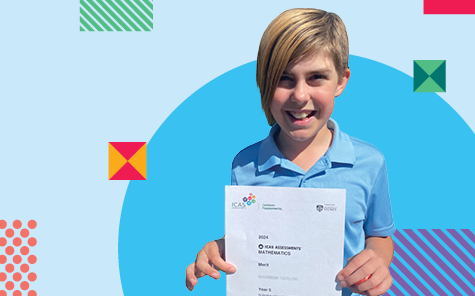
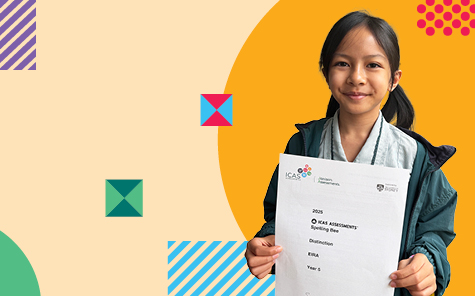
student with ICAS certificate

The internationally-recognised gold standard in academic competitions

The ICAS competition is an internationally recognised academic challenge that gives students from Years 2 to 12 the opportunity to test their skills, stretch their thinking and be recognised for their achievements beyond the boundaries of everyday schoolwork.

Each year, students across Australia, New Zealand and more than 40 other countries take part in ICAS tests across six literacy and STEM subjects. It’s a meaningful academic challenge, and one students can feel genuinely proud to be part of.

A trusted school competition built on over 40 years of expertise

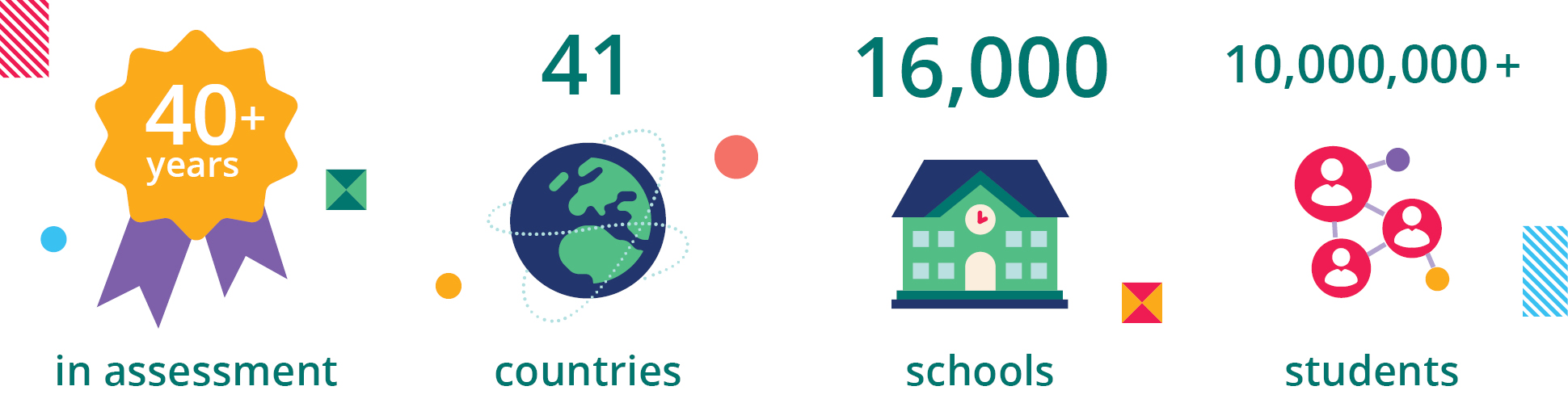
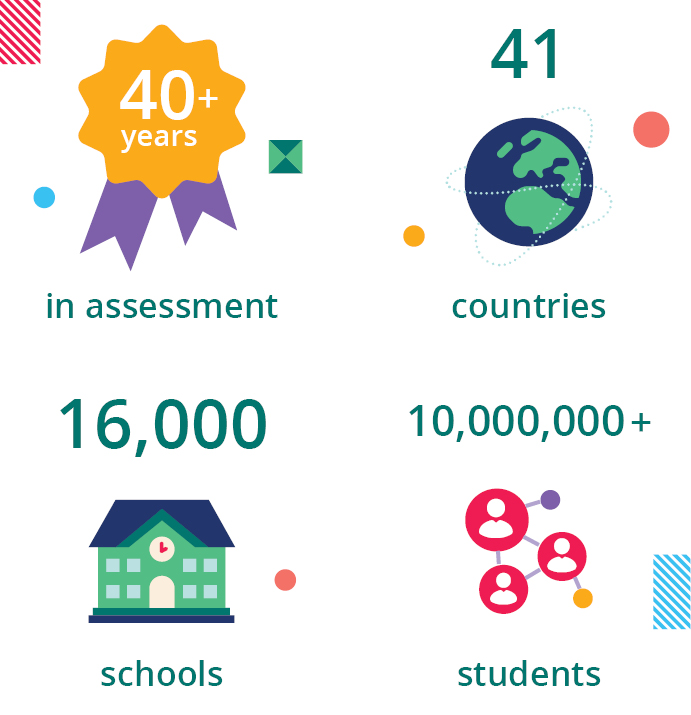
ICAS is the internationally recognised gold standard for school academic competitions. Since 1981, more than 10 million students from 16,000 schools across 41 countries have experienced ICAS, making it one of the most trusted academic competitions in the world.

Backed by the University of Sydney in Australia and developed by leading assessment experts, ICAS is designed to the highest standards of fairness, rigour and educational value.

icasa statistics horiztonal
icasa stats square

The benefits of participating in the ICAS competition

Participating in ICAS gives students something beyond a school result: a nationally recognised benchmark, meaningful recognition for their effort, and the confidence that comes from taking on a real academic challenge.

A challenge worth taking on

ICAS assessments go beyond the standard curriculum — designed by experienced teachers, education experts and psychometricians to stretch students’ thinking and reward higher-order thinking.

Recognition that means something

Every student who participates receives a certificate. The highest achievers earn Distinctions, High Distinctions and ICAS medals, which are recognised nationally and backed by over 40 years of academic credibility.

Insights schools and parents can act on

ICAS results provide detailed, independently benchmarked data, helping schools refine teaching programs and giving parents a clear, external view of their child’s academic progress.

Confidence built through challenge

Taking part in the ICAS competition gives students the experience of applying their skills under real academic conditions. It builds resilience, motivation and a healthy appetite for learning.

ICAS test subjects

ICAS offers six competitive subjects across literacy and STEM, each designed to stretch students beyond the standard curriculum and reward higher-order thinking. Whether a student has a passion for writing, a talent for numbers or a curiosity for science, there’s a meaningful challenge waiting for them.

The ICAS English competition tests reading comprehension, language conventions and literary analysis, challenging students to engage critically with a wide range of text types and think carefully about how language works.

The ICAS Mathematics competition goes well beyond calculation, challenging students to apply mathematical reasoning, logical thinking and creative problem solving to questions they won’t find in their textbooks.

The ICAS Science competition explores scientific reasoning, data interpretation and inquiry skills — encouraging students to think like scientists and apply their curiosity to real-world contexts.

The ICAS Digital Technologies competition tests computational thinking, digital problem solving and technology concepts, preparing students for an increasingly tech-driven world.

The ICAS Writing competition gives students the opportunity to express their ideas with creativity, clarity and craft, assessed on both the quality of their writing and the strength of their thinking.

The ICAS Spelling Bee is a fun, engaging challenge that builds vocabulary, strengthens spelling accuracy and gives students a genuine sense of achievement, whether they’re competing for the first time or aiming for a top result.

ICAS test year levels for Australia

The ICAS competition is designed to be age-appropriate and genuinely stretching at every level, with questions calibrated by year level so students are always challenged in a purposeful, fair way.

Outside Australia? Find the corresponding year levels here.

Year 2 is the perfect time to start. The ICAS competition gives younger students their first taste of an academic challenge, building confidence and curiosity from the very beginning.

Year 3 students are developing their foundational skills across literacy and numeracy. ICAS gives them the opportunity to apply those skills in new and engaging ways.

At Year 4, students are ready to think more deeply and independently. The ICAS competition stretches their analytical thinking and rewards effort at every level.

Year 5 students are gaining confidence across all subjects. ICAS challenges them to go beyond the classroom, testing creativity, reasoning and the application of what they’ve learned.

As students approach the end of primary school, ICAS gives them a meaningful academic benchmark and a confidence boost heading into the next stage of their education.

Starting high school is a big step. The ICAS competition gives Year 7 students an early opportunity to establish their academic identity and measure their abilities on a national stage.

Year 8 is a great time to take on an academic challenge. ICAS pushes students to think harder, reason more clearly and take genuine pride in their academic abilities.

With senior school on the horizon, Year 9 students benefit from the rigour and independent thinking that ICAS demands, building habits that will serve them well in future exams.

The ICAS competition at Year 10 level is a challenging academic experience that prepares students for the demands of senior schooling and gives them a clearer picture of their strengths.

For Year 11 students, ICAS is both a meaningful challenge and an independent benchmark, providing valuable insight alongside their school-based assessments as they prepare for their final year.

Year 12 students can take on ICAS as a final, nationally recognised academic challenge that rewards excellence, provides a credible external measure of their abilities to support tertiary applications.

How the ICAS competition works

parent smiling academic competition

For schools

ICAS is designed to be worthwhile for your students and straightforward for your school to deliver. Learn how other schools run ICAS and how we support you every step of the way.

girl holding icas certificate

For parents

Give your child a meaningful academic challenge and recognise their effort and achievement. Find out what ICAS involves, how to get your child registered and how to help them get ready.

quote icon

Who creates ICAS

ICAS test questions are developed to the highest academic standards by a dedicated team of experienced classroom teachers, education measurement experts and psychometricians.

Every question is designed to push students beyond the day-to-day curriculum, rewarding creativity, higher-order thinking and the ability to apply knowledge in new contexts.

Questions are rigorously reviewed and refined each year to reflect current student interests, ensure age-appropriate challenge, and maintain the fairness and rigour that ICAS is known for.

Chelsea Bernal

Chelsea Bernal, Head of Test Development

How school academic competitions compliment standardised exams to assess, inspire and motivate students

In 1845, American educational reformer Horace Mann introduced one of the first standardised assessments for students, designed to identify learning gaps and help teachers tailor their methods to improve outcomes. Much has changed in schools since then, but the value of external assessment has endured. What’s also grown, significantly, is the role of academic competition alongside it.

What is the difference between an academic competition and a standardised exam?

Standardised exams are typically designed to measure what students know relative to a curriculum baseline, giving teachers and schools data to identify gaps and adjust their programs accordingly. Academic competitions have a different purpose: they’re designed to motivate, challenge and reward students who are ready to go further than the everyday classroom allows.

The two are natural partners. Where standardised exams highlight what students have learned, academic competitions challenge students to apply that knowledge in new, more complex ways, testing creativity, reasoning and the ability to think under pressure.

How school academic competitions evolved

School competitions didn’t gain widespread popularity until the growth of mass communication: radio, television, and eventually the internet. One of the oldest continuous academic competitions on record began as a radio quiz program for high school students in the United States in 1948, testing general classroom knowledge. The energy and friendly rivalry it generated proved contagious. That program, the Delco Hi-Q quiz, expanded into a national event that continues today, more than 75 years later.

Today, academic competitions are significantly more refined and data-driven. The best competitions don’t just test what students have memorised. They extend students beyond the day-to-day curriculum, rewarding those who can analyse complex problems, apply their knowledge creatively and demonstrate higher-order thinking.

What is ICAS, and how did it begin?

The ICAS academic competition began in 1981 and grew rapidly to become Australia’s most popular school competition. ICAS is now offered internationally, with over 10 million students from 16,000 schools across 41 countries having taken part in one or more of the six competitive literacy and STEM assessments.

ICAS is built around a simple but powerful idea: that academic achievement deserves the same recognition and celebration as sporting achievement. Students who take part in the Icas competition sit a timed assessment in a structured exam environment, giving them real, valuable practice for the kinds of high-stakes assessments they’ll face later in their education.

The ICAS exam is developed each year by a team of psychometricians, education measurement experts and experienced teachers. Every question is crafted to stretch students, spark curiosity and reward those who think beyond the obvious answer. Questions evolve continuously to reflect student interests and maintain engagement, so the ICAS test always feels fresh, relevant and genuinely challenging.

Why academic competitions matter for high-potential learners

One of the most compelling arguments for competitions like ICAS is the opportunity they create for students who are ready to be extended. Standardised assessments, by design, benchmark the middle. Academic competitions are designed for students who are ready to go further, and they provide a meaningful, motivating context to do so.

Students who take part in the ICAS competition experience what it feels like to compete academically at a national level. They learn to handle challenge with composure. They discover strengths they may not have known they had. And they receive recognition through certificates, medals and nationally benchmarked results that feels genuinely earned.

Perhaps the most compelling parallel is sport. Children can tap into their naturally competitive natures through football, cricket, swimming and dozens of other pursuits. Academic competitions offer that same opportunity, giving students a chance to compete and be recognised for their intellectual abilities in the way athletes are celebrated for their physical ones. For many students, that experience is genuinely transformative.

The biggest difference between academic competitions and standardised exams isn’t the content. It’s what they’re designed to do. ICAS is designed to inspire. To give students a challenge they’ll feel proud of. To build the kind of motivation and love of learning that no single classroom assessment can fully provide.

To learn more about what makes ICAS worthwhile for students and schools, explore our blog.
FAQs

ICAS (the International Competitions and Assessments for Schools) is a nationally recognised academic competition for students in Years 2 to 12 (in Australia – see year levels for other regions). It challenges students across six literacy and STEM subjects, benchmarks their performance against national peers and recognises achievement at every level.

ICAS has been running for over 40 years and is trusted by schools across Australia, New Zealand and more than 40 other countries worldwide.

ICAS is open to students in Years 2 through 12. Any student can take part. It's not limited to top performers.

ICAS is designed to challenge and reward students at every level of ability, so whether a student is entering for the first time or aiming for a High Distinction, ICAS has something meaningful to offer.

Students can enter the ICAS competition in up to six subjects: English, Mathematics, Science, Digital Technologies, Writing and Spelling Bee.

Students can enter one subject or several, depending on what the school and family decide.

The ICAS test is a timed written assessment, sat in a structured exam environment at school. Each paper is made up of multiple-choice and written questions designed to stretch students beyond the standard curriculum. Assessment dates vary by subject and are scheduled across a window of weeks in Term 3.

The ICAS competition is an external, independently benchmarked assessment, which means results reflect how a student performs against a national peer group, not just their own class or school.

Where a school exam assesses curriculum coverage, ICAS assesses a student's ability to apply knowledge creatively and solve complex problems. The two complement each other well.

Every student who takes part in ICAS receives a certificate. The type of certificate reflects their result: Participation, Merit, Credit, Distinction or High Distinction. The top-performing student in each subject and year level in their region receives an ICAS medal, one of the most prestigious academic awards available to school-aged students.

The ICAS competition sitting dates for 2026 are:

  • Digital Technologies: 3–7 August
  • Writing: 3–7 August
  • English: 10–14 August
  • Science: 17–21 August
  • Spelling Bee: 17–21 August
  • Mathematics: 24–28 August

Yes. ICAS past papers are available to purchase as practice materials, giving students the opportunity to familiarise themselves with the style, format and level of challenge they can expect. Check out our full range of practice tools here.

Ready to start?

Whether you’re a school looking to give your students a meaningful academic challenge, or a parent wanting to understand what ICAS can offer your child, we’re here to help. Explore the next step that’s right for you.