How a science teacher’s belief in skill-based assessments helped set the career path for Australian University of Oxford immunology star
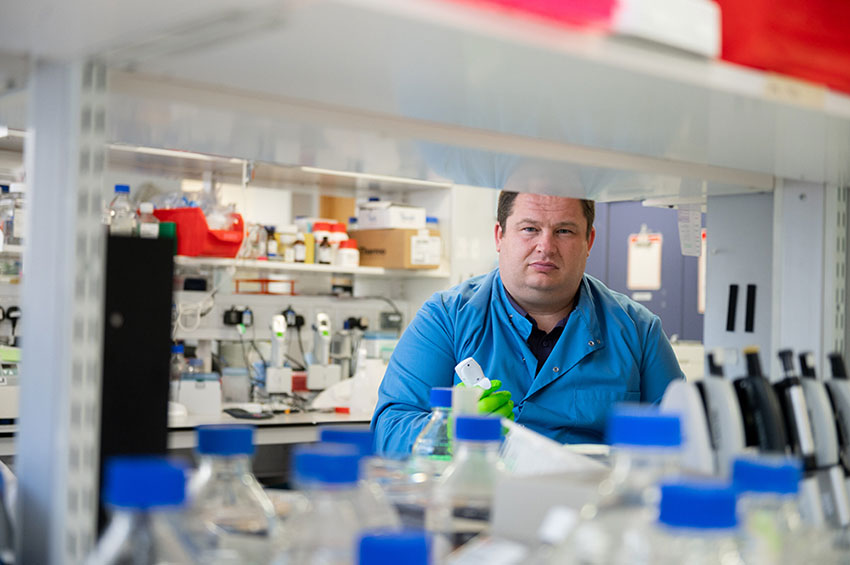
Adam Ritchie at the Jenner Institute in Oxford. PHOTO: John Cairns
Sydney teacher Julie Carrington has long been an advocate of the International Competitions and Assessments for Schools (ICAS) for its novel approach to measuring academic strengths and its ability to uncover potential and untapped talent within the classroom.
In her experience, an independent tournament which involves students from hundreds of other schools can also be a motivator for young people to dig deeper. “I was part of our school’s gifted and talented staff team for many years, and I’ve always sought outside competitions for students to participate in so that they may extend themselves,” says the science leader of 40+ years at Sydney Technical High School.
Sydney Technical High School is a selective school, known for academic excellence. That said, like in all manner of schools across the country, there are many bright students who don’t necessarily shine within the more conventional school testing methodologies. It’s why over the years Julie has been particularly passionate about securing other opportunities and forums in which classroom talent can emerge. “We’re always acknowledging the students who do well academically, however I find ICAS is important for identifying gifted and talented underachievers,” she says.
“That’s how I found Adam.”
A gifted underachiever who shunned conventional rote learning
Former Sydneysider Adam Ritchie is an expert in immunology at the University of Oxford and whose unique experience makes him a leading expert in taking new vaccines from the lab to the beside. He is a key member of the team who helped bring Oxford’s COVID-19 vaccine to the world in 2020, via manufacturer AstraZeneca. After completing a doctorate in the field of host pathogen interactions, Adam pursued post-doctorates in various diseases including mad cow disease, malaria and HIV, consequently spending six years advising international policymakers and ambassadors on preparing for a pandemic.
A move to another area of the University saw him working on a platform for manufacturing vaccines cheaply at volume, particularly within impoverished parts of the world. It was from here that, in 2020, he was called upon to work on the programme for rapid production of the Oxford COVID vaccine, starting before COVID-19 was declared a global pandemic.
Long before that, Adam was one of Julie’s students. She defines gifted and talented underachievers as those with an innate intelligence, but are perhaps not able to apply themselves to learning the work “and therefore in the exams, they might not shine.” At the time that he was in Julie’s Year 10 science class in the 1990s at Sydney Technical High, Adam fitted this profile.
As well as it not being uncommon for him to land himself in school detention for his behaviour, academically Adam was impatient with the pace and logic of rote learning, often preferring not to revise for school examinations. Julie had an inkling that he would thrive within an academic scenario which leans more towards student who have a strong predilection for high-order thinking and problem-solving.
She arranged for the science class to have the opportunity to sit ICAS Science, and encouraged Adam, then in Year 10, to sign up. “At our selective high school, the students are often very willing to go into a number of different competitions and it’s encouraged. We’re in an ideal situation,” she says.
Her instinct turned out to be right. Weeks later Adam, who until then was better known for being summoned to the principal’s office to receive an admonishment than a congratulations, achieved a rare perfect score in his ICAS Science paper: 100%. This achievement turned out to be one of the pivotal turning points in his exploration of his interest in palaeontology, which grew into a mentorship program at University of NSW and eventually brought him to Oxford.
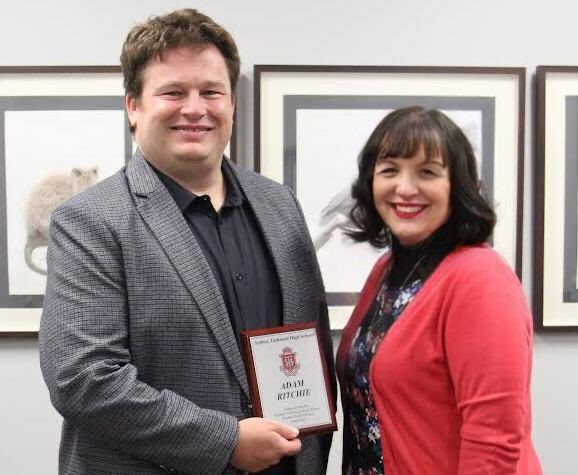
Adam Ritchie with Julie Carrington, his former science teacher at Sydney Technical High School
‘We’re all a bit odd’: The sideways minds behind ICAS
Each year, ICAS exam questions are developed in a meticulous 12-month creative process by an in-house team of school education specialists, psychometricians, statisticians and experts in exam authoring and reporting. Great care is taken to ensure not just academic integrity and sophisticated skill measurement, but also to reflect real-world contemporary scenarios as well as an outside-the-box, at times quirky, approach to school subjects.
Nick Connolly, ICAS Head of Analysis and Reporting, who began his long tenure on the team writing puzzling maths questions for the competition, says: “You can do creative things with subjects that people don’t think of as being particularly creative. I’d say the people who thrive on the ICAS team are usually a bit odd – they think sideways; they look creatively at what appear to be routine tasks.”
It’s exactly this approach, combined with the test’s high academic quality, that appeals to teachers such as Julie. “The beauty of ICAS is that it explores a sophisticated way of thinking. And this can often be a wake-up call for the student. And for us identifying these students,” she says.
Julie also believes ICAS is unrivalled when it comes to uncovering gifted students such as Adam. “How many of them are out there? We don’t know,” she says.
Taking higher-order thinking to nurture Oxford’s next generation
Part of Adam’s role at Oxford is to support student admissions and mentor undergraduates. Thanks in part to the nurturing of his own talent for problem-solving which began with Julie and competitions such as ICAS, he is able to perceive this spark in applicants, seeing who can dig deep and bring more to the table than an excellent aptitude for recalling facts.
True to the intellectually maverick predisposition he displayed in high school, even within this institutionally elite setting he’s fearless when it comes spotting the diamonds in the rough.
“I’ve admitted thousands of students to Oxford and rejected more,” he says. “I’ve had people write to the British Prime Minister to say that I’ve rejected them and shouldn’t have because they are Oxford material. But our mission is to not have so narrow a scope that we end up with the same [type of] student over and over again.”
He continues: “We are not only looking for academic ability but asking ourselves: What does that academic ability look like in different settings?”
Adam recalls one of his favourite graduate admissions which illustrates this at work. He says: “this was someone from a fragile state who had not always been in formal education. While they were able to go to University, there grades were good without quite being what we’d normally be looking for. But through written work and interview we saw there was real potential there, and were able to bring them to Oxford with a full scholarship. They thrived at Oxford, and since graduating they’ve gone on to have increasing influence in their home country.”
Adam teaches his own undergraduates that there are many more dimensions to learning than committing learning materials to memory: “Now when I talk to my Oxford undergraduates about what matters, I tell them rote learning is a thing people get addicted to. If that is all you can do it’s meaningless. But if I give you a question and you work out how to answer it, that’s valuable.”
Think there might be some untapped talent in your school or family? Read more about ICAS Science and find out about ICAS 2023 dates and subjects here.
Tag:Case study, customer story
You may also like

How science competitions build critical thinking