

How science competitions shape future scientists
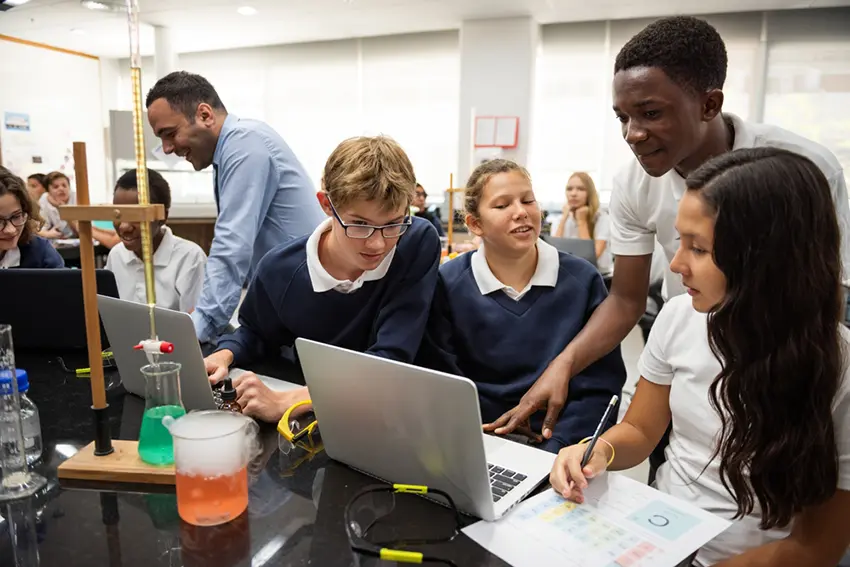
Every scientist started somewhere. For some, it may have been a question asked at the dinner table, a bug collected in a jar, or a challenge at school that made them sit up and think “this is awesome.”
Research suggests those early moments matter more than we might expect. A science competition is one of the simplest ways to turn a child’s natural curiosity into skills, confidence and, for some, a lifelong path.
Here’s what the evidence says, and how parents and schools can help to fan kids’ natural sparks.
Why early interest in science matters
A study published in Science followed thousands of students from the age of about 13 through to university. Those who said in Year 8 that they were interested in a science-related career were two to three times more likely to graduate with a science degree 12 years later.1
One finding stands out for parents: students with average maths results but a genuine interest in science were more likely to earn a physical science or engineering degree than high maths achievers without that interest.2 Marks matter, but interest matters too.
That interest often starts even earlier. In a study of chemists and physicists, 65 per cent said their interest in science began before secondary school. Many of the women in that study credited school-based experiences, including science competitions, for creating the spark.3
The challenge is keeping that spark alive. Researchers have observed that students’ engagement with science tends to decline as they get older, which makes encouragement in the primary and early secondary years especially valuable.1
How science competitions build interest in STEM careers
So where do science competitions fit in? A large US study of around 15,000 students found that those who took part in STEM competitions at school were more likely to be interested in a STEM career by the end of high school, even after accounting for the interest they had beforehand. The effect was stronger for students who took part in more than one competition.4
In the Australian Government’s STEM toolkit for schools, they suggest that STEM competitions help children build creativity, collaborate and solve problems, while providing a motivating challenge that raises awareness of possible STEM careers.4
Those career pathways are real and growing. In the 20 years to February 2020, employment in Australian STEM occupations grew by 85 per cent, more than twice the rate of non-STEM jobs.5
Of course, not every child who enters a science competition will become a scientist, and that’s fine. Workforce development is only a small part of the picture. The bigger goal is a scientifically literate community that can understand and weigh up the science that shapes our everyday lives.1
What a good science test really measures
When parents hear “science test”, as with many assessments, they might believe that a good score is achieved by memorising facts. But a well-designed science test goes way beyond that, inviting students to think like scientists instead.
The ICAS Science test uses real scientific stimulus material, such as graphs, diagrams and descriptions of experiments, to assess five core skills:6
- Observing and measuring: noticing detail and recording it accurately
- Interpreting: making sense of data, tables and diagrams
- Predicting and concluding: using evidence to work out what is likely to happen, and why
- Investigating: understanding how a fair test is designed
- Reasoning and problem solving: applying what they know to unfamiliar situations
A Year 3 student might work out how weather affects different regions across Australia. A Year 9 student might generate a hypothesis about what will happen when certain chemicals are mixed, or evaluate an experimental report. Either way, the focus is on applying knowledge in new contexts, not simply recalling it.
These are skills that serve students well in every subject, and well beyond the classroom.
Confidence, recognition and seeing themselves as a scientist
Interest grows when children start to see science as something that’s “for me”. Taking part in a science competition gives them a clear, external signal that their effort and thinking are valued.
In ICAS, every student who takes part receives a certificate, and the highest achievers in each state are awarded medals. That recognition can be a real confidence boost, whether a child earns a Participation certificate or a High Distinction.
Sometimes it does more than that. One Sydney student sat ICAS Science in Year 10 after a teacher encouraged him to give it a go. His result revealed a talent for problem-solving that eventually led him to a career in immunology and a role in the COVID-19 vaccine effort.
The key is framing. The Australian Government’s guidance recommends that schools and families focus on participation and learning rather than winning or losing.4 When the emphasis is on having a go, a science competition becomes a positive challenge rather than a source of pressure.
Why schools should offer a science competition
For educators, a science competition offers more than an enrichment opportunity. It can complement classroom programs by giving students a meaningful academic challenge beyond the day-to-day curriculum, while keeping high-potential learners engaged.
A well-designed science test also provides useful evidence. ICAS results are reported by skill area and question, helping teachers identify cohort strengths, spot learning gaps and benchmark performance against national peers. That information supports planning, targeted teaching and more meaningful conversations with parents.
Participation is designed to be manageable too. With the Parent Payment System, there is no cost to schools and no money to collect, and support is available from registration through to results.
Give your child the chance to take part in a science competition
The scientists of tomorrow are in classrooms today, asking questions, testing ideas and discovering what they enjoy. A science competition won’t decide their future, but it can help them see what they’re capable of.
Parents: ICAS Science is open to students from Years 2 to 12 (AU) and Years 3 to 13 (NZ), as well as various year levels for other countries. Ask your child’s school whether they’re taking part in ICAS 2027, or find out how your child can enter.
Educators: learn more about why to participate in the ICAS competition and give your students a meaningful science challenge this year.
References
- University of Virginia: What makes a student decide to become a scientist? (2019)
- University of Virginia: US science leadership depends on early encouragement (Tai et al., Science, 2006)
- InformalScience.org: Interest and motivation are linked to science learning and future career choices (cites Maltese & Tai, 2010)
- Australian Government Department of Education: STEM competitions (cites Miller, Sonnert & Sadler, 2018)
- National Skills Commission: Australia’s shift to a higher skilled, services-based economy (2021)
- ICAS Science subject page
Tag:Academic competition, ICAS, Science, STEM
You may also like
How science competitions build critical thinking