• Assessments portal
  • Results login
    • Schools
    • Parents
  • Support
    • Schools
    • Parents
    • Locked-down browser
    • Device setup
    • Webinars
  • Contact
  • Assessments portal
  • Results login
    • Schools
    • Parents
  • Support
    • Schools
    • Parents
    • Locked-down browser
    • Device setup
    • Webinars
  • Contact
ICAS Assessments
  • For schools
    • Why host ICAS
    • Reporting & insights
    • What’s involved
    • Entry fees
    • Achievement levels
    • Grants
    • Celebration
  • For parents
    • Why participate
    • Achievement levels
    • Understanding results
    • How to prepare
    • Entry fees
    • Scholarships
    • How to participate
  • Dates
  • Subjects & year levels
    • Subjects
    • Year levels & exam papers
  • About
    • About ICAS
    • Success stories
    • Blog
  • For schools
    • Why host ICAS
    • Reporting & insights
    • What’s involved
    • Entry fees
    • Achievement levels
    • Grants
    • Celebration
  • For parents
    • Why participate
    • Achievement levels
    • Understanding results
    • How to prepare
    • Entry fees
    • Scholarships
    • How to participate
  • Dates
  • Subjects & year levels
    • Subjects
    • Year levels & exam papers
  • About
    • About ICAS
    • Success stories
    • Blog
Buy past papers
Enter ICAS 2026
Buy 3 past papers, get 1 FREE (T&Cs apply). Hurry, ends soon! Buy now 

7 brilliant lesson planning tips from teachers (infographic)

lesson planning tips from teachers

Lesson planning is one of the most important regular tasks you’ll complete as a teacher, and it’s incredibly time-consuming.

We asked our former teachers (with decades of collective experience) for their biggest lesson planning tips – the things that helped them to speed up the process while ensuring that their students were achieving their key learning outcomes.

Here they are! We recommend saving the image and referring to it when you need 🙂
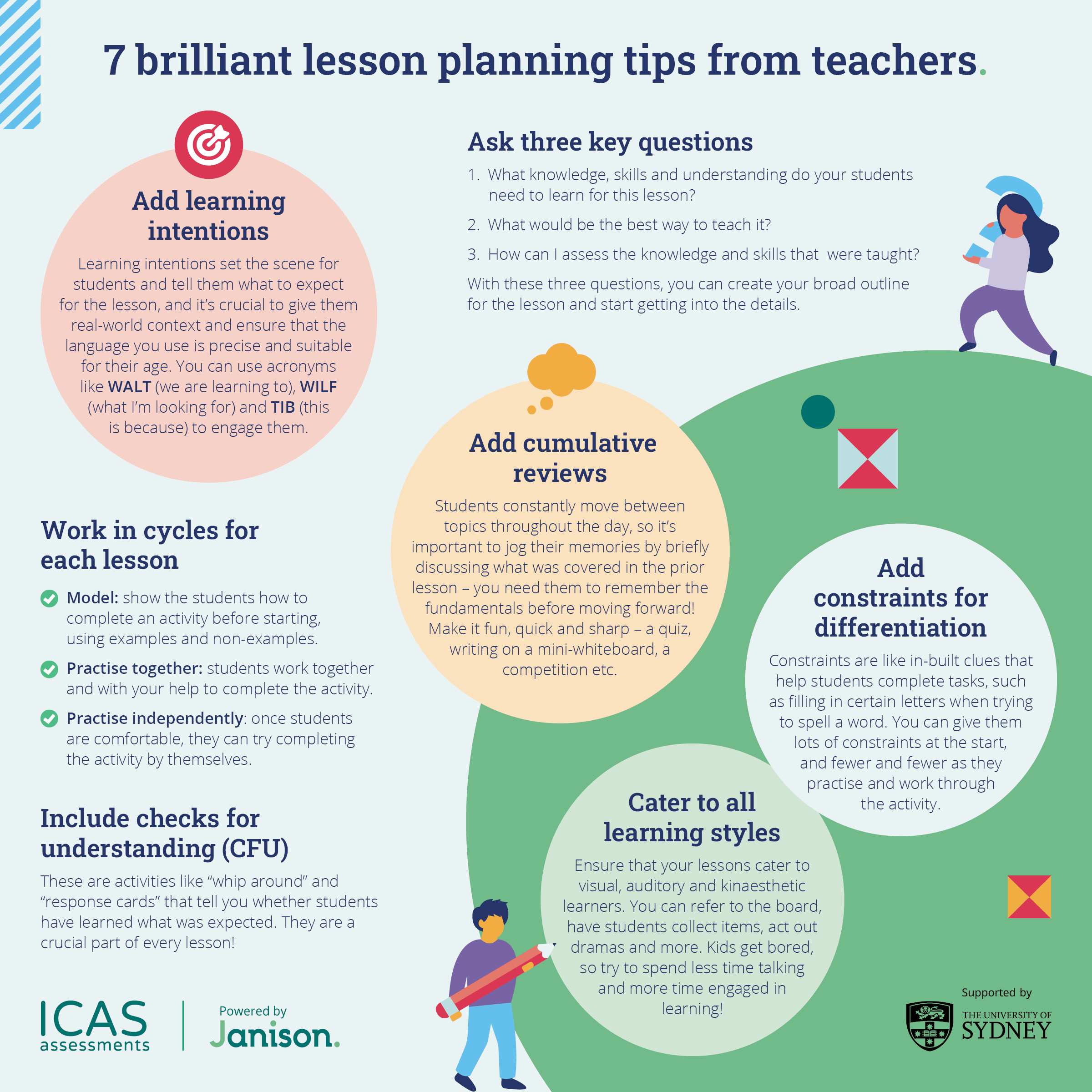
lesson planning tips from teachers infographic ICAS

1. Ask three key questions

  1. What knowledge, skills and understanding do your students need to learn for this lesson?
  2. What would be the best way to teach it?
  3. How can I assess the knowledge and skills that were taught?

With these three questions, you can create your broad outline for the lesson and start getting into the details.

2. Add learning intentions

Learning intentions set the scene for students and tell them what to expect for the lesson, and it’s crucial to give them real-world context and ensure that the language you use is precise and suitable for their age. You can use acronyms like WALT (we are learning to), WILF (what I’m looking for) and TIB (this is because) to engage them.

3. Add cumulative reviews

Students constantly move between topics throughout the day, so it’s important to jog their memories by briefly discussing what was covered in the prior lesson – you need them to remember the fundamentals before moving forward! Make it fun, quick and sharp – a quiz, writing on a mini-whiteboard, a competition etc.

4. Work in cycles for each lesson

  1. Model: show the students how to complete an activity before starting, using examples and non-examples.
  2. Practise together: students work together and with your help to complete the activity.
  3. Practise independently: once students are comfortable, they can try completing the activity by themselves.

5. Add constraints for differentiation

Constraints are like in-built clues that help students complete tasks, such as filling in certain letters when trying to spell a word. You can give them lots of constraints at the start, and fewer and fewer as they practise and work through the activity.

6. Cater to all learning styles

Ensure that your lessons cater to visual, auditory and kinaesthetic learners. You can refer to the board, have students collect items, act out dramas and more. Kids get bored, so try to spend less time talking and more time engaged in learning!

7. Include checks for understanding (CFU)

These are activities like “whip around” and “response cards” that tell you whether students have learned what was expected. They are a crucial part of every lesson!

Tag:lesson planning, teaching

    Previous post

    How ICAS tests and strengthens curriculum-based skills
    June 14, 2023

    Next post

    Enhancing your assessment schedule with higher order thinking
    June 19, 2023

    You may also like

    kids-doing-science-competition
    How science competitions build critical thinking

    March 24, 2026
    dungog primary
    How an ICAS grant helped Maitland–Newcastle challenge its brightest learners
    March 10, 2026
    boy practising for icas writing
    5 practical tips on how to be successful at ICAS Writing
    March 28, 2025

    Search

    Our products

    ICAS
    Reach
    ICAS assessments logo

    The fun, competitive and inspiring challenge for bright, young minds.

    ACN 081 897 494

    Assessments portal

    Results
    Schools
    Parents

    Support
    Schools
    Parents
    Locked-down browser
    Device setup
    System status updates

    Testing centres

    Reach

    Data-led Education Equity Program (DEEP)

    Terms & Conditions
    Refund Policy

    Get ICAS updates

    Contact

    Email us

    Australia toll-free: 1800 931 775

    New Zealand toll-free: 0800 440 904

    International: +61 2 5565 2217

    Facebook Linkedin Youtube
    Supported by The University of Sydney
    ICAS assessments logo

    World-class assessments
    driving student success.

    ACN 081 897 494

    For schools
    Why host ICAS?
    Reporting & insights
    What’s involved
    Entry fees
    Achievement levels
    Grants

    For parents
    Why participate?
    Achievement levels
    Understanding results
    How to prepare
    Entry fees
    Scholarships
    How to participate

    Dates

    Subjects

    Year levels & exam papers

    Testing centres

    Reach


    Assessments portal

    Results
    Schools
    Parents & students

    Support
    Schools
    Parents & students
    Locked-down browser
    Technical support

    About
    About ICAS
    Our team
    Success stories
    Blog
    Data-led Education Equity Program

    Terms & Conditions

    Refund Policy


    Contact us

    Email us

    Australia toll-free: 1800 931 775

    New Zealand toll-free: 0800 440 904

    International: +61 2 5565 2217

    Facebook Linkedin Youtube
    Supported by The University of Sydney
    Janison
    Janison assessments logos

    © ICAS Assessments. Powered by Janison. All rights reserved.

    About Janison | Privacy Policy | Terms of Use | Refund Policy

    • For schools
      • Why host ICAS
      • Reporting & insights
      • What’s involved
      • Entry fees
      • Achievement levels
      • Grants
      • Celebration
    • For parents
      • Why participate
      • Achievement levels
      • Understanding results
      • How to prepare
      • Entry fees
      • Scholarships
      • How to participate
    • Dates
    • Subjects & year levels
      • Subjects
      • Year levels & exam papers
    • About
      • About ICAS
      • Success stories
      • Blog
    Buy past papers
    Enter ICAS 2026
    • Assessments portal
    • Results login
      • Schools
      • Parents
    • Support
      • Schools
      • Parents
      • Locked-down browser
      • Device setup
      • Webinars
    • Contact