Enhancing your assessment schedule with higher order thinking

If you’ve spent precious hours working out your school’s assessment schedule for the year, with every test carefully considered and added to the proper date, the last thing you want to do is jam in a surprise assessment and shuffle things around.
But sometimes, the reshuffles are worth it. While the curriculum is your first priority, if you want students to perform at their very best and prepare them for the future, you’ll need to go beyond the curriculum and test their higher order thinking skills. These advanced skills allow them to think more deeply about concepts across the entire curriculum, adding a richness to your assessment schedule that can be difficult to find elsewhere.
Children start developing higher-order thinking skills between the ages of 7 and 11,1 and ICAS can help you develop and test them. Every question in ICAS is written to specifically test these skills for students, stretching their abilities and adding a new level of depth to their learning. It tests them on abstract concepts like humour and friendship; encourages them to connect familiar concepts like Earth to new concepts like planetary movement; invites them to combine and alter pre-existing ideas to create something fresh, and perhaps most importantly, it helps them to solve whatever future problems are in front of them (ICAS or not).
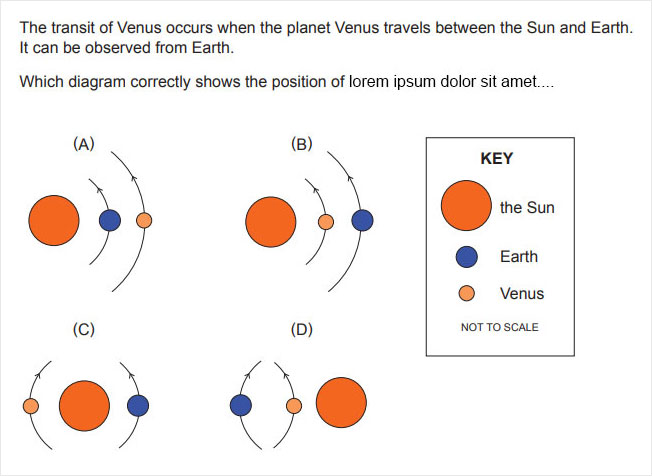
Example of an ICAS Science question for Year 3 students
“Each year, we create ICAS questions that are focused on problem-solving and higher order thinking, keeping a focus on appropriate language demand, context, and their relevance to the curriculum.”
 Kerry Tremaine, Head of Assessment Content, Janison Assessments
When sitting the ICAS exam for a core curriculum subject, students are invited to exercise the part of their brain that allows them to apply concepts to new situations, analyse and compare ideas, evaluate different options, and synthethise new forms of knowledge to develop a deeper understanding of the topics at hand – the mid and upper echelons of Bloom’s Taxonomy. While testing for ICAS, they’re essentially brushing up on the curriculum-based skills that are fundamental to their learning outcomes, but using higher order thinking rather than rote learning. We’ve seen troublesome students who struggle with rote learning shine like diamonds when taking ICAS, even going on to save lives. In these instances, it’s often because the style of the ICAS test urges students to access a more advanced form of thinking that goes next level in terms of skills, which many students find fun and engaging. What better way to support their learning outcomes? A study by Richard Herrnstein (author of the famous book The Bell Curve) revealed that American students who were given critical thinking lessons made significant improvements in language comprehension, inventive thinking and overall IQ.2 ICAS is a test rather than a lesson, but students are tapping into the very same critical thinking skills that bolster these benefits. Their future university professors may thank you dearly for it, not to mention their employers.
Despite higher order thinking skills being so important for progress, they can be notoriously tough to test, especially for new teachers. It takes experience and creativity to craft questions that encourage critical thinking and problem solving, and given that there may be multiple solutions, even harder to create marking criteria for them. That’s why it takes our test development team over a year to create every new set of ICAS assessments. They work carefully to ensure that every question tests the higher order thinking and problem-solving capabilities of students, while also relating to the common curriculum skills found in Australia, New Zealand, and numerous other countries where ICAS is sat. Their rigour can be hard for teachers to match.
The ICAS competition extends and enhances the higher order thinking skills that you may already be teaching your students, giving them a platform to demonstrate what they’ve learned and the opportunity to be recognised for their achievements. If you’d like to enrich your assessment schedule with ICAS, you can purchase the competition here. We promise the schedule reshuffling is worth it!
 Written by Nardin Hanna
Nardin is a former primary school teacher of 10 years. During her time as a teacher, she served as Head of Years for K-2, was a trained NAPLAN marker, and was part of the team that wrote the 2021 NSW English Syllabus 3-6. She is currently an assessment consultant for ICAS and Reach.
References
- Alicia Nortje, Ph.D, 2021, Piaget’s Stages: 4 Stages of Cognitive Development & Theory, Positive Psychology
- Raymond S. Nickerson, 1988, On Improving Thinking Through Instruction, Review of Research in Education
You may also like

How science competitions build critical thinking