8 fun ways to improve literacy and numeracy at home

As a parent, you may have already witnessed your kids’ astonishing natural ability at picking up words. It’s one of the many joys of parenting. But despite having the foundations of language entrenched in their brains from birth, they still need plenty of “training” to become skilled speakers, readers and writers. The same goes for numeracy – a less natural but equally important skill.
Thankfully, there are plenty of fun ways for your child to improve their literacy and numeracy skills at home, and become full-fledged wordsmiths or mathematicians (maybe both!)
These are some of the best ways for your child to boost their literacy and numeracy abilities at home, from toddlers to teenagers.
8 proven methods for improving literacy and numeracy skills
1. Reading

“Pleasure-readers average higher scores in every subject due to their general literacy being better.”
Our first recommended activity is perhaps the most obvious for improving your child’s literacy skills: reading for pleasure. Bountiful research backs up this claim, with adolescent pleasure-readers averaging higher scores in every subject due to their general literacy being better.1 Literacy underpins everything, after all!
The important thing here is pleasure. The most enduring reading habits are forged from books your child actually enjoys, so try to encourage them to read whatever they are interested in, fiction or fact. A variety of books helps too because it provides exposure to different words, but this is less important than choosing books for the sake of enjoyment.
And of course, reading to them from a young age will not only help with their language development, but can be a wonderful way to kickstart a lifelong reading habit.
2. Chatting
Speaking is a crucial component of literacy. It’s your child’s ability to articulate sentences, pick the right words, adopt the appropriate tone, and more. It’s nothing less than their ability to express themselves, and one of the best ways to improve it is by chatting with them as often as possible.
You can ask how school was, what they learned, which subjects they enjoyed, how their friends are doing, what they think of a current event, and countless other topics. You can try “active listening” through encouraging nods and smiles, reflect certain statements back to them to urge them to think more deeply, and validate their feelings as often as possible.
In essence, try to be a supportive, friendly companion for them. With every warm, attentive conversation, you’re helping to develop their language skills and building a stronger bond.
3. Storytelling
Humans are hardwired for stories. They’re our way of making sense of the world; of colouring it with meaning. They are also an effective way for your child to develop their literacy skills.
When constructing stories, your child is tapping into their visual and verbal creativity, allowing them to weave original tales of heroes or dragons or anything that interests them, with plots that are complex or simple, short or multi-chaptered, illustrated, acted dramatically, and everything in between. The beauty of storytelling is that they can say whatever they want, in whatever way they want. And all the while, they’re improving their ability to express themselves through language.
4. Journaling
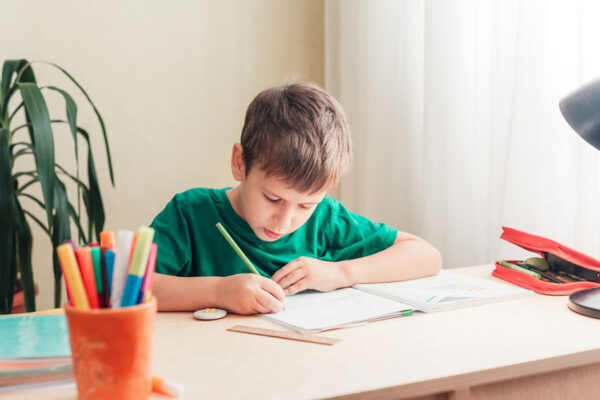
Journaling is a personal, reflective way for your child to hone their writing skills. As with stories, the topics covered in journaling can be about anything they want – how school went that day, something that has recently been bothering them, what they intend to do in the future, and so much more.
The exercise can be structured with pre-set questions/prompts, or used as a way to freely express themselves. If your child likes the idea of journaling, encourage them to write about whatever they want. They can share it with you or keep in private. The important thing is that they just write.
In addition to helping develop literacy skills, journaling can also improve your child’s emotional intelligence, help them make decisions, express their fears, and so much more.2 It’s a fantastic exercise for anyone.
“Journaling is a personal, reflective way for your child to hone their writing skills.”
5. Games

For helping your child improve their numeracy skills, the first recommendation in our list are good old-fashioned games. Whether it’s Snap, Uno, Monopoly, Sudoku, Connect Four, Snakes & Ladders, or the innumerable other games available to play, provided they involve numbers (even just dice), they’re an entertaining way to boost numeracy skills. This includes board games, card games, digital games, and even jigsaw puzzles (which help with spatial awareness).
Games can help your child recognise numbers, add, subtract, multiply and divide them, see how they relate to each other or fit into patterns, how they work with measurements, and other numeracy-related skills that are crucial to their development. And they’re a great way for your family to bond!
6. Imaginative play
For young children, imaginative play is a powerful technique for improving their creativity and social development. And when it involves numbers, it boosts their numeracy skills at the same time.
Number-based imaginative play usually involves running pretend shops with their own tills – cupcake businesses, award-winning cafés, that sort of lucrative thing – with you paying for your little one’s goods and getting the right amount of change. They might also use old computer keyboards or calculators – whatever allows your child to work with numbers. And who knows…you could ignite an entrepreneurial spark where they’ll one day be able to look after you.
7. Sports
“Every sport uses number-based scoring systems that provide numeracy practice for your child.”
AFL, soccer, cricket, basketball – every sport uses number-based scoring systems that provide numeracy practice for your child. It gets more challenging for games that have varied points for different actions, like cricket with its single runs, four-pointers and six-pointers, not to mention the number of different wickets, overs and bowls.
Your child can gain the numeracy benefits of sports from both playing or watching, though the former is preferable as they’re exercising and building social relationships (including language skills) at the same time. Plus there’s a reason that sports have lasted through the ages: they’re a lot of fun!
8. Bake together

Our final numeracy-based recommendation is also the most delicious: baking treats!
Cookies, cupcakes, muffins, flapjacks… they all require precisely-measured ingredients which help your child sharpen their numeracy skills. The baking process can include the use of all-important fractions, counting, anticipating and measuring heights of baking tins, converting different measurement types like ounces and grams, and more key numeracy skills.
With hot ovens and knives around the place, they’ll need to be supervised of course, and you can use this opportunity to guide and assist them while they whip up something delicious. And in case you were wondering, our team will happily welcome any treats you might like to post.
References
- Christy Whitten et al., 2016, The impact of Pleasure Reading on Academic Success, The Journal of Multidisciplinary Graduate Research
- Amanda Morin, 2021, The Benefits of Journaling for Kids, VeryWell Family
You may also like

How science competitions build critical thinking