Essential literacy and numeracy skills for students

Words and numbers – they permeate our lives from our very first breath to our last. They allow us to express ourselves, communicate, make sense of the world; to measure things, build things and do our taxes.
There isn’t a part of our lives they don’t touch – no wonder literacy and numeracy skills are so important for developing children. When these skills are lacking, their entire education is hampered, along with their chances of economic success1 and having happy, meaningful social lives.2
As a teacher, you already know the importance of literacy and numeracy. This article will provide you with a concise breakdown of the primary skills that make up each of them, so that you can better understand what your students need to flourish.
These skills are based on the current version of the Australian curriculum, but overlap with curriculums around the world. You can see overviews of both skills in the curriculum here: literacy and numeracy.
The four essential literacy skills
Literacy skills can be grouped into two basic categories: the receptive skills of reading and listening, and creative skills of writing and speaking.
Reading
Reading is a fundamental literacy skill that requires students to comprehend, interpret and analyse passages of text – stories, essays, questions and more.
To be an effective reader, students must have the following sub-skills:
- Vocabulary – a bank of words appropriate for their age, which they understand in the context of sentences.
- Grammar – an understanding of how sentences are structured and meant to be comprehended.
- Fluency and prosody – the ability to read with expression at an appropriate speed while understanding the text at the same time.
- Visual – in the context of reading, this is students’ ability to interpret graphs, tables, maps and other images that must be “read” and understood.
Listening

Listening is the second key receptive skill for literacy. It allows students to understand what is being said, filter relevant information, collaborate with their classmates and more.
The primary sub-skills of a good listener include:
- Focus – listening requires maintained attention; to hear what the speaker is saying and effectively interpret their meaning. This is why children with ADHD can have difficulties with learning. It’s a crucial skill.
- Locating specific information – not everything that a speaker says may be relevant (nobody’s perfect), so students must be able to pick out the information that helps them achieve their goals. This includes specific details, and understanding the general gist of what is being said.
- Understanding instructions – a student must follow plenty of directives throughout their schooling, and even more as working adults. They need to perceive exactly what is being asked of them.
- Making inferences – not everything is black-and-white. Sometimes students need to make inferences based on what is being said – an important higher-order thinking skill often required for challenging academic competitions like ICAS.
Writing
The written word is all around us – in websites, apps, books, signage. It’s a primary method for expressing ourselves and guiding our actions in the world.
To be an effective writer, a student must have a good command of:
- Vocabulary – without adequate vocabulary, expression is stunted. A student won’t be able to express themselves well if they don’t have the right words to match their feelings and intent.
- Spelling – challenging as it can be, spelling is an important skill for accurate expression. It allows the reader to understand exactly what is being said, without misinterpretation or confusion.
- Grammar, syntax and punctuation – this allows students to structure their sentences using the agreed rules for English, including using the correct tenses, pronouns, conjunction and connectives; the correct subjects, objects, predicates, clauses and more.
Speaking

The other important creative sub-skill is speaking – something we’ve been doing for about 200,000 years and have gradually gotten better at (though you might not know it from some modern pop lyrics).
In addition to the vocabulary and grammar skills listed above, articulate speakers must have the following sub-skills:
- Pronunciation – to accurately convey meaning, words must be pronounced correctly and clearly.
- Tone – tone can drastically change how a conversation is understood and felt. Students need to select the tone that is suited to their meaning: formal, informal, assertive, humorous, optimistic, and many more varieties.
- Fluency – an effective, engaging speaker should be able to select the right words and the right time and say them at the right pace.
The four essential numeracy skills
Numeracy is more than just numbers. It extends to how students interact with the space around them, how they recognise models and patterns, how they divide things up into smaller units and more.
These are the fundamental literacy skills that students need to have.
Numbers
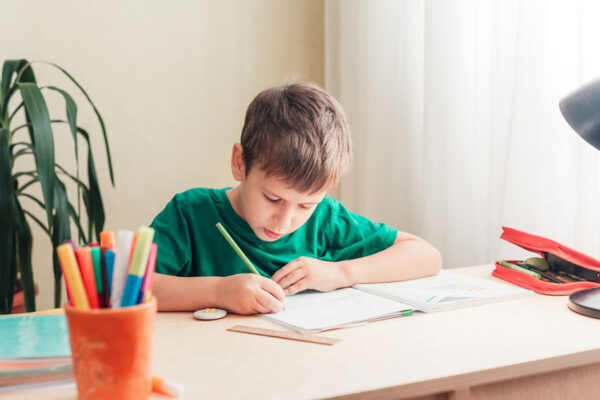
 Photo by Cats Coming
Numbers are so ingrained into our way of life that it’s easy to forget they’re a made-up concept (though some argue they exist independently in nature). This abstract series of symbols, ranging from just 0 to 9, allow us to understand and manipulate our world in astonishing ways.
To wield the immense power of numbers in their lives, students must understand:
- Estimating and calculating – working with whole numbers (often money) to estimate and calculate required values. Includes the all-important use of arithmetic.
- Fractions – the essentials on how we slice and dice our world into smaller units, including the use of decimals, percentages, ratios and more.
- Statistics – how data is used to analyse, interpret and present information, as well as make predictions based on chance.
Patterns
In contrast to numbers, we’re born to recognise patterns. It’s how we learn to predict the world and acquire the things we need to thrive.
But as with any skill, there are levels, and your students need to gradually reach them. These are some of the important sub-skills they must learn for patterns:
- Pattern recognition – the ability to recognise when numbers, objects or words are forming patterns, and what that might mean for each specific context.
- Pattern prediction – understanding a pattern well enough to be able to predict what comes next.
Measurements
 Photo by Karolina Grabowska
Pretty much everything built for a useful purpose has been measured. It’s why our bridges stay erect, our houses remain upright, our televisions don’t blind us, etc.
To gain a solid grasp of measurements, your students will need to understand:
- Types of measurement – physical things can be measured in length, width, area, volume, capacity and mass; time can be measured in seconds, minutes, hours and more. Students must be able to work with these common types of measurement.
- Working with measurements – you can’t do much with a measurement alone. They need to be estimated, compared, calculated and more to become useful.
- Time – punctuality is crucial in our modern world, which means understanding how clocks, calendars and timetables work.
Spatial reasoning
Spatial reasoning is our ability to understand and manipulate objects in space. At its most basic level, it’s a baby learning to grab his own feet.
For your students, it means learning these key concepts:
- Space and direction – how objects are positioned in space, and which directions or planes they can fill or move in: two dimensions, or three. This includes working with 2D and 3D shapes.
- Maps and diagrams – understanding small-scale abstract representations of the real world such as maps, and how they are used to good effect.
Interested in learning more? Find out some key ways you can improve literacy and numeracy at your school.
References
- Dr Kate de Bruin et al., 2023, Supporting students significantly behind in literacy and numeracy, Australian Education Research Organisation
- 2013, Low literacy and numeracy skills hurt Australians and the economy, ACER
You may also like

How science competitions build critical thinking